Questions about storing chemicals can generally be grouped under the following headings: What? How long for? How? and Where?
What chemicals to store
There are not too many restrictions here:
Legally speaking aside from some obscure aromatic amines, nothing is actually banned.
SSERC has a list of ‘Banned’ chemicals which includes things like benzene, arsenic and some other nasties. You should avoid these.
Other than that, the biggest thing to remember is to under no circumstances store Tollen’s Reagent.
How long for?
There is no need to have a blanket disposal policy. It is wasteful and expensive. The ‘expiry dates’ on bottles represent the date beyond which the manufacturers will not guanrantee their purity, that’s all. And this is much less relevant in a school than in, say, a forensics lab.
Some chemicals have a Safe Shelf Life (eg potassium metal) these can become hazardous if stored for longer.
Other have a shelf life (eg ammonia) they don’t become hazardous but may cease to be of use.
For the rest, as long as they are still doing what you want them to, you can keep them as long as you like. Things like marble chips will last centuries.
Where?
As a general rule of thumb about what to store where:
The simple answer is ‘in a chemical store’. This should be fire resistant, lockable (with not too many keys in circulation) and convenient – ideally opening off the prep room but certainly not far away from it.
It is often a little more complex than that. It is best practice to keep as much of your chemical stock in the chemical store as you can but that may not always be possible.
- In the lab – Small amounts of Low hazard chemicals, Harmful (Ac Tox 4), or Irritant (Cat 2)
- In the prep room – Low hazard chemicals in larger amounts, Gas cylinders, radioactives*
- In the chemical store – Everything else
* There are various other restrictions about storing radioactives so this may not be the best place.
Security
The chemical store should be kept locked at all times when it is not actually in use. Anyone inside must be able to get out without needing a key so they cannot be locked in. Access should be limited: the precise details will depend on the school or college but in general all the technicians should have access and most of the the teachers shouldn’t. No pupils should have access.
How?
Within your sto0re, you can’t just put things on shelves or in cabinets willy-nilly. As well as needing a system to enable you to find things, there are certain safety considerations as well.
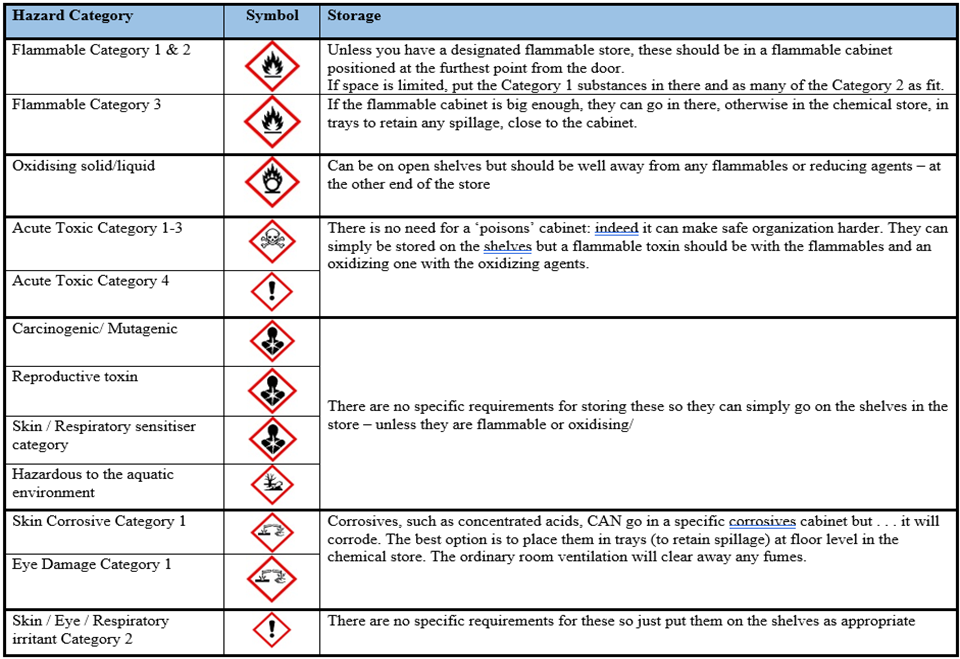
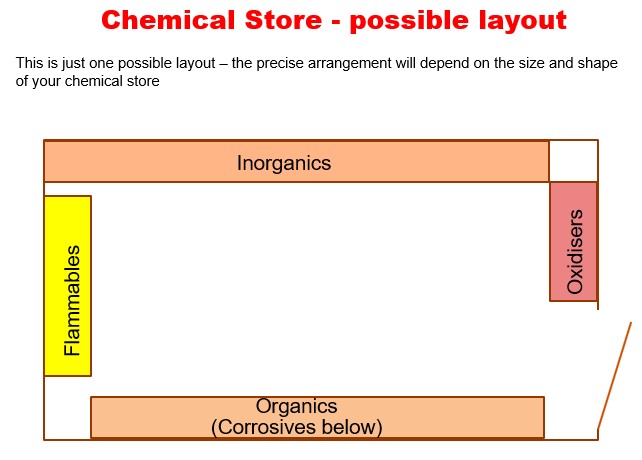
Flammables – these often need to be stored in metal flammable cabinnets, though if your store has suitable fire resistant construction there is no need. Whether on shelves or in cabinets, flammables need sufficient ventilation to make sure there is no chance of an explosive atmosphere developing. They should also be as far from the door as possible so if there is a fire, escape is unhindered.
Oxidisers – These can be kept on the shelves with other chemicals but it is sensible to group them together as the vital thing is that they are kept away from reducing agents and especially from flammables.
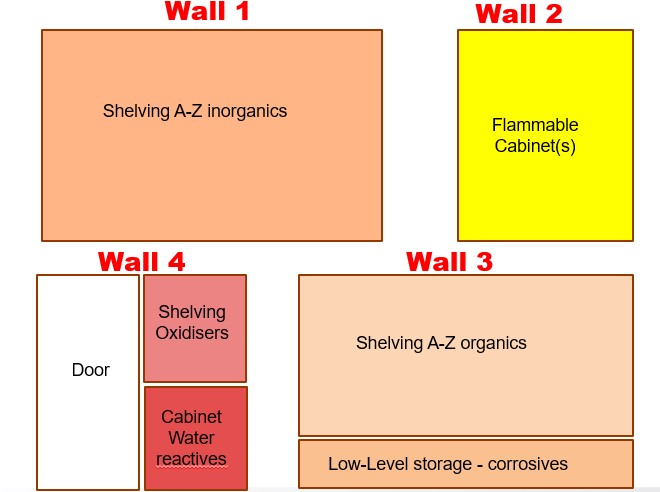
Corrosives – There is no need to keep corrosives in cabinets in a chemical store. The cabinets will rust due to the fumes. We suggest in trays at floor level in the chemical store where the room ventilation will remove the fumes
Water reactive metals – such as alkali metals. These should be in their original bottles under oil, inside the plastic containers these came in and in anotehr box or cabinet to make absolutely sure no water can come into contact with them.
Inorganic and organic reagents – these can simply go on the shelves. You can separate them into organic and inorganic or mix them together. It doesn’t matter.
Chemical Store layout
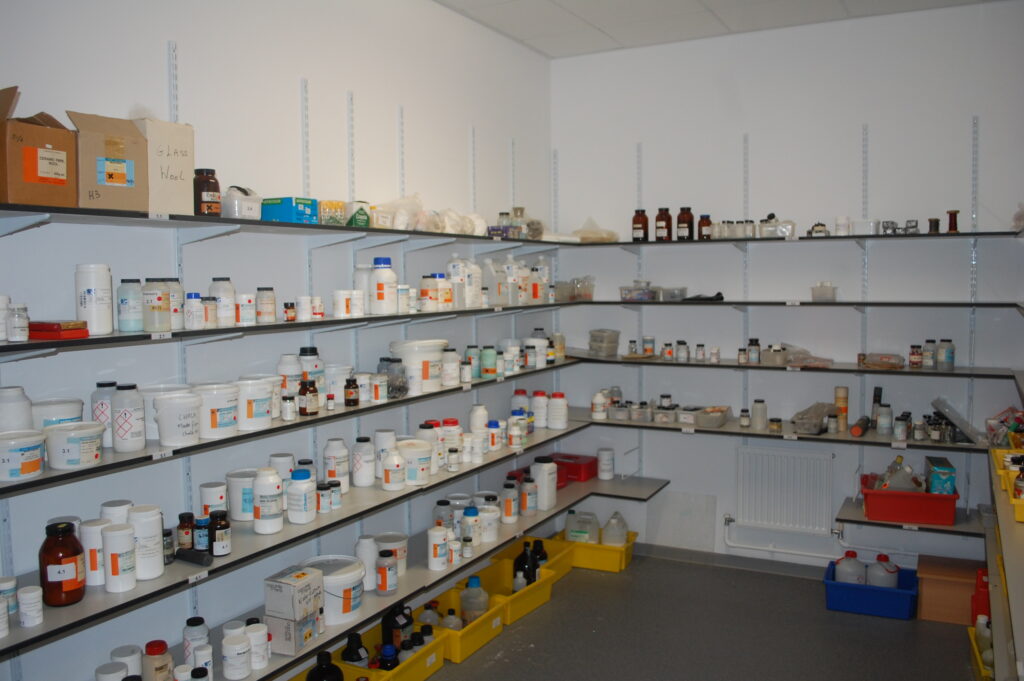
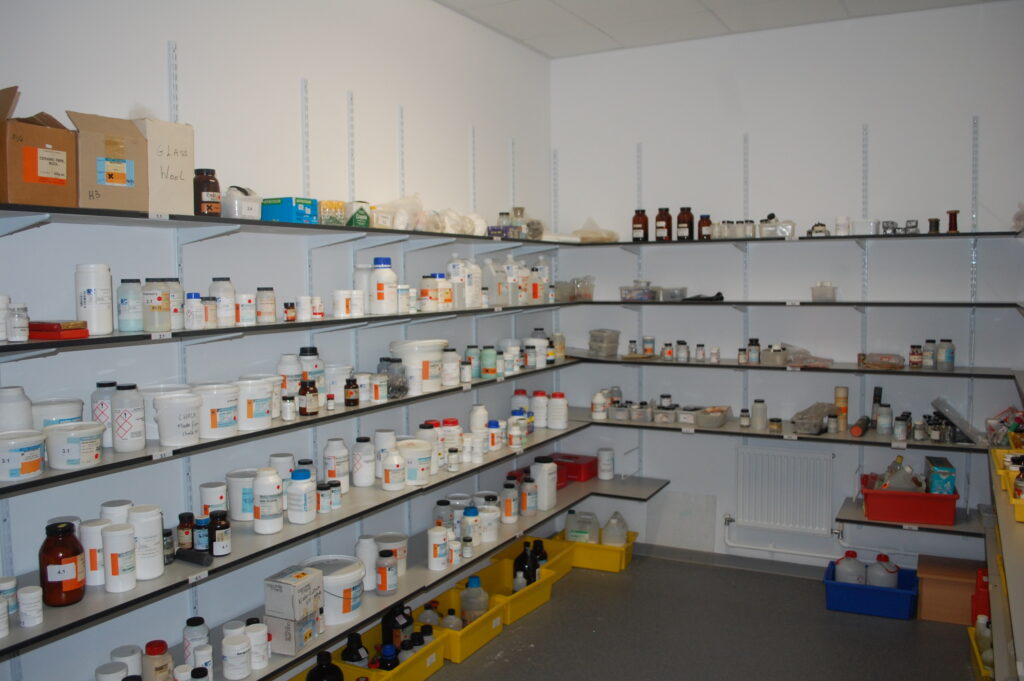
A possible arrangement is shown in the two images below. (One birds-eye view and another showing how the shelf lauout would appear).
Shelving
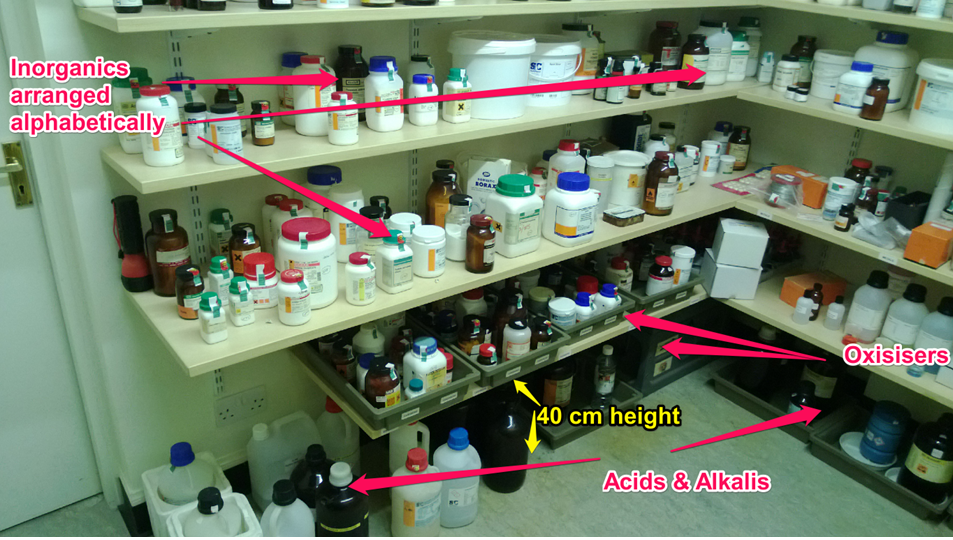
This image shows part of a possible arangement.
Shelves shouls be far enough apart to enble you to easily reach things and not too deep that you are likely to knock things off when you reach for them.
They should be fixed firmly to a solid wall ir be part of a freestandig unit. Lips on shelves are optional.
Summary
The video below gives a run through most of the issues discussed above and shows you some actual chemical stores.
The table below is my version of one from the support documents with some extra comments.
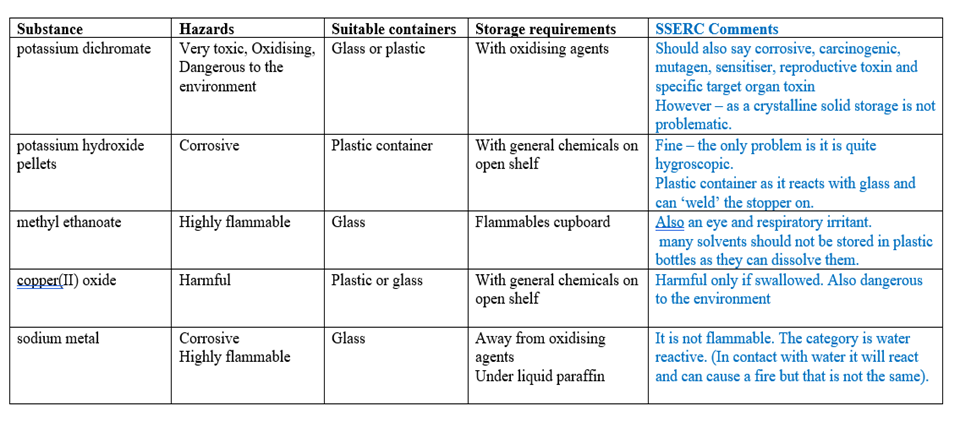
And here is another table that gives general guidance about how to store chemicals based on their labels and hazard categories.