
Once you have determined the hazards and who might be harmed and how, assess the level of risk for the activity and then control those risks so that harm is unlikely. This is done using control measures – the health and safety term for any sort of protective measure that you put in place to reduce the risk of harm.
You are not expected to eliminate all risks
The only way to do that would be to to do no practical work.
There are various methods of judging the category of risk we at SSERC prefer a simple system.
Decide for any significant hazards whether the risk is high, medium or low.
High = seriously consider whether you should carry out the activity.
Low = No issues. Go ahead without precautions.
Medium – OK as long as you put some control measures in place, eg wear eye protection
You can further divide this group into
- activities that are best done as teacher demonstrations
- activities that are fine for a class to do
Risk Matrices
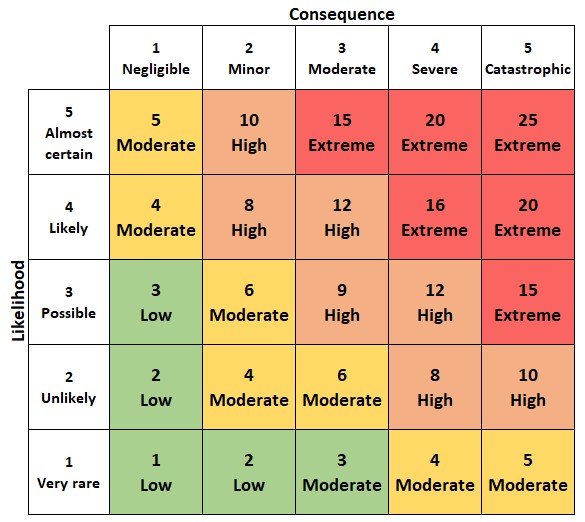
Some employers suggest (or insist on) the use of risk matrices similar to the one on the left.
If your employer tells you to use one then you must but SSERC does not recommend their use.
In our view, they are not especially helpful. While it may make the final assessment simpler in some cases, all that happens is endless discussion about the particular likelihood or consequence rating. In addition, we have a natural antipathy towards using numerical values for things that are not measurable in numerical terms. What doe a possibility of 3 even mean?
Hierarchy of Control Measures
There are various categories of control measures but they are not all equal. The diagram below shows a generally accepted hierarchy for them.
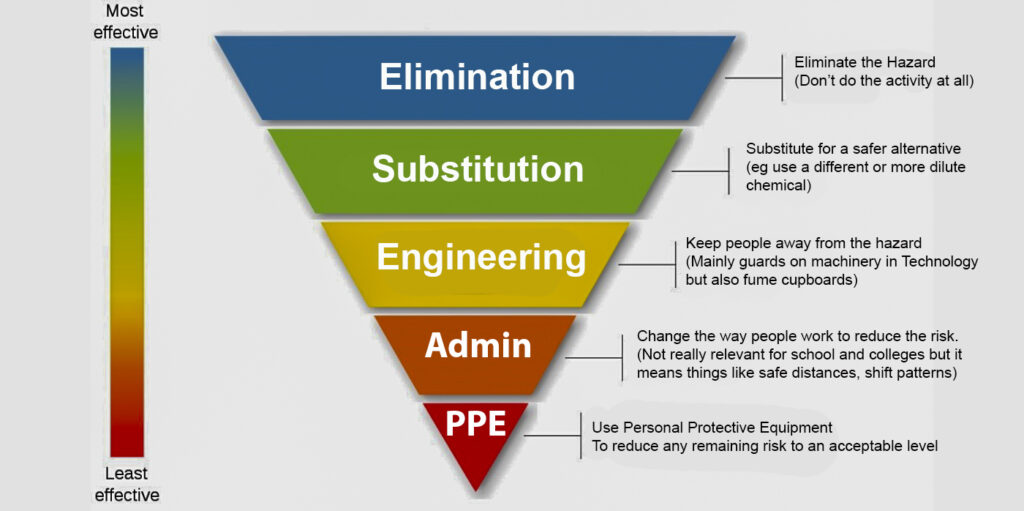
PPE is the last line of defence. It should only be used, if needed, once you have reduced the risk to as low as possible by all other means.
Personal Protective Equipment (PPE)
In a school or college science or technology setting, PPE includes the following:
- Eye protection: Safety spectacles, indirect vent goggles or even a safety shield, depending on the level of risk.
- Gloves: usually disposable when dealing with corrosives or substances toxic by skin absorption – but also gauntlets for some concentrated acids.
- Lab Coats: In general, lab coats are NOT PPE, but they are considered as such in microbiology.
- RPE (Respiratory Protective Equipment): SSERC does not recommend the use of this, except dust masks for brief periods as needed. In general RPE needs expert fitting and training to work well and we feel there is a danger of a false sense of security.
In order to be effective, items of PPE should be suitable for the hazard(s), in good condition and fit properly.
If the risk assessment determines PPE is needed, then it must be worn. – by all who are near the hazard. This means teachers as well as all learners. And the rules about this should be enforced.