
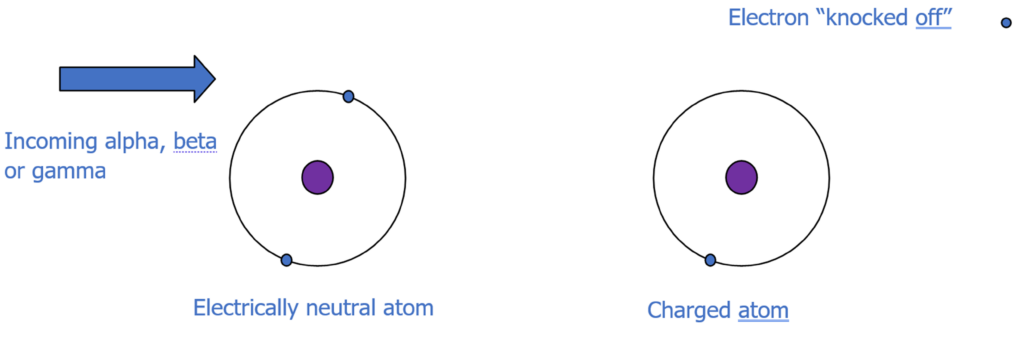
Alpha, beta and gamma radiation (and X-rays) can cause ionisation. This is when an electron orbiting an atom is separated from the atom by the radiation. Because the balance of electric charges in the atom has been disturbed, the atom is electrically charged. We say that the atom has become ‘ionised’.
Light, radiowaves, infrared, microwaves and ultraviolet are all forms of radiation, but they do not cause ionisation, so they are not classed as ‘ionising radiation’.
We can detect radiation due to the ionisation that it causes.
If ionisation takes place in a living cell, it can cause harm. This is why there is specific legislation dealing with ionising radiation (the Ionising Radiations Regulations, 2017 – IRR17).
Alpha radiation is the best ioniser, gamma is the poorest.
Dose
Activity is a property of a radioactive source.
Dose is not the same as activity. Dose is a quantity that lets us evaluate the likelihood of harm to an individual who has been exposed to radiation.
Dose depends on the following:
- The energy from radiation deposited per kilogram in living tissue
- The type of radiation (alpha, beta, gamma etc)
- The type of tissue absorbing the radiation.
Dose is measured in Sieverts (Sv). When discussing work in schools, we will normally be dealing with microsieverts (μSv) or nanosieverts (nSv). Sometimes we will mention millisieverts (mSv).
1000 mSv = 1 Sv
1000000 μSv = 1 Sv
1000 000 000 nSv = 1 Sv